
Privacy Policies are required by law for blogs too. The specific laws governing Privacy Policies vary by country, as do the specific clauses they should contain, but there are some commonalities we'll discuss in a moment.
Keep in mind that if your blog collects personal, private information for any reason and you're not compliant with privacy regulations, you are leaving yourself open to potentially severe consequences.
As you may or may not know, it wasn't that many years ago that the European Union established its signature privacy law known as the General Data Protection Regulation (GDPR). Since then (May 25, 2018), a slew of similar legislation has passed worldwide, and they all demand that bloggers post a Privacy Policy.
Now, you might not think that a blog is where you might collect personal information, but you would be wrong.
Consider, for example, that you might collect information, such as the name, email address, home address, and telephone number of someone filling out a form on your blog, etc. Analytics services also collect legally protected personal information, such as IP addresses. Literally hundreds of thousands of bloggers collect information defined as "personal" and "private" according to global privacy laws.
Before we get to clauses, you should be aware of the major pieces of privacy legislation that mandate the need for your blog to have a Privacy Policy.
These laws include:
Canada's Personal Information Protection and Electronic Documents Act (PIPEDA)
The California Online Privacy Protection Act (CalOPPA)
The California Consumer Privacy Act (CCPA), as amended by the CPRA
Europe's General Data Protection Regulation (GDPR)
Australia's Privacy Act
The UK's Data Protection Act
Third Parties and Privacy Policies
If you are using third-party services requiring your customers to submit their personal information, you will need to have a Privacy Policy. For instance, you might use an analytics service to enhance your blog visitors' experience, or perhaps you allow ads on your blog.
One of the biggest reasons third parties require bloggers to post a Privacy Policy has to do with their practices regarding cookies and the vast amounts of data those cookies collect.
With that said, here are only a few examples of third-party services, the use of which would require you to have a Privacy Policy:
Google Analytics
Google AdSense
Google AdWords
Amazon Associates
ClickBank
Facebook Pages, Stores, and Apps
Google Play Store
Apple's App Store
As you can see, most of these services are reputable and trustworthy, but it's important to remember that you need to disclose how you're using them in your Privacy Policy.
What Kinds of Personal Information Do Blogs Collect?
As a blogger, you should know that you can collect a wealth of personal information about your readers - information that can help you target your marketing efforts more effectively.
Like many other website owners, bloggers can use a wide range of technologies to draw in more readers and then convert them into customers and buyers. Some bloggers use affiliate marketing methods, and others engage in ecommerce.
And, as previously mentioned, still others allow advertisements on their blogs
However, these aren't the only technologies that capture the personal information of a blog's visitors. Indeed, the ways in which you may capture personal information are many and varied.
Below we'll get into the types of personal information that blogs can collect, and we'll explore some of the ways you can put that data to use.
Your Email List
First off, if you're a blogger and you aren't attempting to grow an email list full of those who read your blog regularly, you're leaving one of the best marketing tactics available to you on the table. It's an extremely effective way to reach current and potential customers. And, it's an excellent way to stay top-of-mind with customers who have already purchased from you.
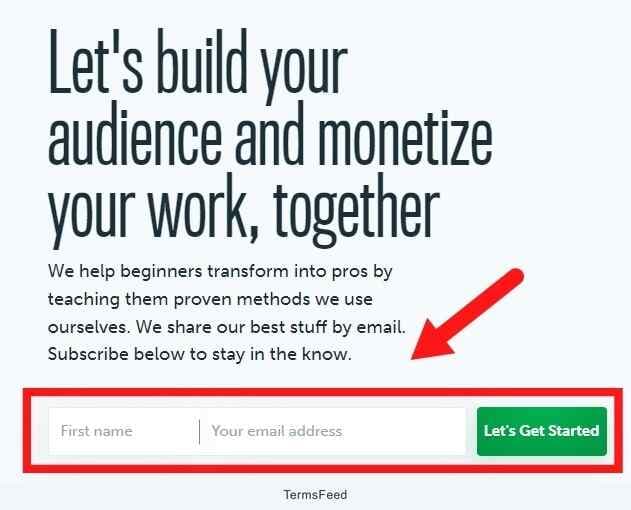
With that said, many well-known bloggers like Pat Flynn of Smart Passive Income use email capture forms before allowing visitors to download a free report, case study, checklist, etc. Some also use them to ask users to sign up for a newsletter.
As shown in the image below, the form asks for specific, identifiable personal data points, such as first name and email address:
Smart Passive Income blog email sign-up form
All by itself, the email capture form is all that's needed to trigger the requirement of a Privacy Policy being posted on the blog. However, the truth is that most bloggers don't just use an email capture form. They use that and many other methods as well.
A Contact Form
A super common feature on blogging websites is a form that allows visitors to get in touch with the blog's author. Similar to email capture forms, a contact form often captures many different personal data points.
Here's an example from Darren Rowse of ProBlogger:
ProBlogger contact form
Notice that the contact form asks for the following personal information:
Name
Email
Website
Live Chat Tools
Live chat can help you connect with readers in real time, and it can provide valuable insights into what makes your fans tick. If your blog engages in either ecommerce or affiliate marketing, these sorts of chat tools can also help turn casual blog readers into buyers.
However, the big deal for our purposes is that your readers have to give up some personal information if they wish to use the chat feature. Usually, that's an email address.
Chatbots
Similar in nature to Live Chats, a chatbot does much the same thing. It engages the blog's readers in a conversation. Chatbots usually answer questions or present FAQs, with the ultimate goal of getting the blog's visitors into a sales funnel.
Chatbots also collect personal information.
Social Sharing Tools
You know the value of ensuring your blog is up to date with fresh content. That's even more true of promoting that content. But creating new content regularly can be difficult, time-consuming, and downright overwhelming.
Luckily, social sharing tools help you get the word out. You might not think so, but each time one of your readers clicks to share a post, personal information is revealed through your blog's connection with the social platform in question.
Well-known blogger Yaro Starak places his social sharing icons in the sidebar of his blog as seen below:
Yaro Starak blog social sharing buttons
Blog Post Comments Sections
Another common area where blog visitors typically give up personal information is within a blog's comments section. Usually, the visitor leaves a name and email address at a minimum.
Of course, this serves a dual purpose. You get the benefit of collecting useful personal information, and at the same time, you increase your blog's engagement and SEO.
Here's an example from ProBlogger:
ProBlogger article comments section: Submit comment form
Payment Checkouts
If you monetize your blog through ecommerce, then your checkout page is an area that collects a massive amount of personal data. The data collection methods on these types of pages can be both direct and indirect.
Notice the many fields the checkout form asks the visitor to fill out before processing their payment. Each of those data points is also shared with third parties.
Thus, having a page like this and collecting these types of information necessitates a Privacy Policy on the ecommerce blog.
Here's an example from Great Jones, an ecommerce site with an excellent blog:
Great Jones create account form
Notice just how much information the form above is asking from visitors.
Third Party Services
Some tasks are better handled by third-party tools when it comes to blogging. For example, here are a few reasons why blogs will use third-party tools:
To create better content. Some tools can help you easily create graphs and charts to accompany your blog posts.
To manage social media. Some services like Hootsuite allow you to easily manage all of your social media accounts from one place.
To collect emails. Services like MailChimp and AWeber allow you to easily manage your email lists.
For better analytics. Google Analytics is a common tool used for this.
You get the idea. These third-party services are standard, and they each collect your visitors' personal data.
Use of Cookies
Did you know that your computer automatically sends information back to the site owner when you visit a website? This is done through cookies, and you can use them to collect a surprising amount of personal information about you.
Cookies are small bits of data that are stored on your visitors' computers or mobile devices. They are used to collect the data necessary to track your visitors' movements around the web, collect information about their activities, and target ads.
In the case of blogging, cookies are often used as part of display and pay-per-click (PPC) activities.
What Information Your Blog's Privacy Policy Should Include
Before you get down to the serious business of writing a Privacy Policy for your blog, there are a few vital things to keep in mind.
A transparent and complete Privacy Policy agreement, which explains exactly what information you collect and how you use it, inspires trust in you and displays a level of integrity in your blog.
Secondly, remember that the tone of your Privacy Policy should be professional and informative. While you may have developed (or are working on developing) a cordial and friendly relationship with your readers, a Privacy Policy is a legal document.
You don't have to be overly formal, but you also don't want to be excessively familiar. With that said, here's what to include.
The Personal Information You Collect
The types of personal information you collect and how you collect it can all be put together in one area. If it is in separate sections because of the details you must provide, best practices are to place these clauses next to each other in the Privacy Policy.
One of the best ways to manage this section is to create a list using bullet points. There are no specific standards you have to follow here, but keep in mind that it can be hard to read when you bunch all the information up into a long paragraph.
Remember: You want the sections within your Privacy Policy to be easy to read and understood without difficulty.
Note how Yaro Starak lists the types of information collected on his blog:
Yaro Starak Privacy Policy: Information collected clause - Information you provide section
How/Why You Use the Information
Just as you must explain how you collect information, it's likewise essential to let your blog's visitors know how and why you use it.
For example, you may use the information for various reasons, including to provide any services, improve those services, personalize content, process payments, communicate with you, comply with laws and regulations, and more.
Here's how ProBlogger discloses this information:
ProBlogger Privacy Policy: How will your personal information be used clause excerpt
Third Party Disclosures
It's easy to see that there will be situations where your blog's readers may not want their information shared with a company other than yourself. It is important that they know about the possibility of such sharing in advance.
That way, if they don't consent or would like more control over what happens to their information when it's shared with others, they can make an informed decision before starting on your site (or any other).
With that in mind, if you do have a relationship with a third party that collects personal information, you must disclose that fact within your Privacy Policy.
Here's how Smart Passive Income does this:
Smart Passive Income Privacy Policy: Who has access to the data we collect - Third party clause
How You Protect Personal Information
What protections have you put in place to ensure that hackers or others don't gain access to your readers' personal information? In this section of your Privacy Policy, you need to note that you've put measures in place to secure the personal information you collect.
Here's how ProBlogger does this:
ProBlogger Privacy Policy: How we manage personal information - Security clause
In addition, you should also list the contact information for your data protection officer (DPO) if you have one.
If you're located in Europe or collect the data of European residents, you must appoint a DPO
under the GDPR.
The Rights of Your Blog Visitors
Ensure your Privacy Policy is clear about the rights of users to delete data, make changes, and review data. Again, this is especially true if your blog collects the personal data of EU residents and the GDPR applies.
Here's how Smart Passive Income notes this and offers a way for readers to contact the blog to exercise the rights:
Smart Passive Income Privacy Policy: User rights clause
Notify Readers of Changes to Your Policy
As a responsible blogger, you have to keep your blog's users in the know about any changes to how you will use their information. Keep them in the loop with clear and concise announcements on revised Privacy Policies so that everyone understands what's going on. Not only is this required by law, but it also builds trust between you and your readers.
This section is usually quite brief, but it is important enough to have its own heading and section. Here's how Smart Passive Income does this:
Smart Passive Income Privacy Policy: Privacy Poliicy Modifications and Updates clause
Contact Information
By now, you should understand how vital it is to be transparent with your customers about what information you're collecting and why.
That's why your blog's Privacy Policy should include your contact information. Including your contact information will help reassure your customers that you're serious about protecting their privacy and that they can get in contact if they have any questions or concerns.
It will also make it easier for them to contact you if they want to unsubscribe from your email list or update their subscription preferences.
Here's how ProBlogger does this in its Privacy Policy:
ProBlogger Privacy Policy: Contact Details clause
Where to Display a Blog's Privacy Policy
You should display your Privacy Policy URL at least in your blog's website footer. This will ensure it will show up to users from every page of your blog.
Here's an example of a Privacy Policy URL in a site footer:
NuCalm website footer with Privacy Policy link highlighted
If you have a cookie consent notice, you can (and should) include a link to your Privacy Policy within the notice, like so:
Diago cookie consent notice
The general best practice is to include a link to your Privacy Policy wherever and whenever you ask users for their information. For example, if your blog has a newsetter, you can link your Privacy Policy to the form where you request their email address to subscribe them to your email list:
Matomo sign up for newsletter pop-up with Privacy Policy link highlighted
Summary of a Blog Privacy Policy
Your Privacy Policy is a significant component of user confidence and legal compliance. The basics covered in this article will help you write a Privacy Policy for your blog that is effective and compliant in most jurisdictions worldwide.
If you spend time considering your information practices and you gather the necessary details before you write your first draft, the task will be less daunting and your finished Privacy Policy will be more thorough and accurate.
The right template can provide you with the inspiration and structure you need. When writing your Privacy Policy, we suggest using the template we provide rather than taking bits and pieces that sound good from other bloggers' policies. This is because you want to ensure that the clauses you include are as relevant as possible.
An alternative we recommend is using our Privacy Policy Generator, which is a great tool. It will ask you applicable questions regarding your blog and the information you collect, and generate a Privacy Policy you can put to use immediately.
Download Sample Blog Privacy Policy Template
Generate a Privacy Policy in just a few minutes
Our Sample Blog Privacy Policy is available for download, for free. The template includes these sections:
Definitions
Collecting and Using Personal Information
Usage Data
Use of Personal Information
Transfer of Personal Information
Disclosure of Personal Information
Security of Personal Information
Detailed Information on the Processing of Your Personal Data
Links to Other Websites
Changes to Privacy Policy
Contact Information
Sample Blog Privacy Policy Template (HTML Text Download)
You can download the Sample Blog Privacy Policy Template as HTML code below. Copy it from the box field below (right-click > Select All and then Copy-paste) and then paste it on your website pages.
<p><strong>Privacy Policy</strong></p>
<p>Our Privacy Policy was last updated on [___DATE___].</p>
<p>This Privacy Policy describes Our policies and procedures on the collection, use and disclosure of Your information when You use the Service and tells You about Your privacy rights and how the law protects You.</p>
<p>We use Your Personal data to provide and improve the Service. By using the Service, You agree to the collection and use of information in accordance with this Privacy Policy. This Privacy Policy was generated by <a href="https://www.termsfeed.com/blog/sample-blog-privacy-policy-template/">TermsFeed Blog Privacy Policy Template</a>.</p>
<p><strong>Interpretation and Definitions</strong></p>
<p><strong>Interpretation</strong></p>
<p>The words of which the initial letter is capitalized have meanings defined under the following conditions. The following definitions shall have the same meaning regardless of whether they appear in singular or in plural.</p>
<p><strong>Definitions</strong></p>
<p>For the purposes of this Privacy Policy:</p>
<ul>
<li>
<p><strong>"Account"</strong> means a unique account created for You to access our Service or parts of our Service.</p>
</li>
<li>
<p><strong>"Company"</strong> (referred to as either "the Company", "We", "Us" or "Our" in this Agreement) refers to [___COMPANY INFORMATION___]</p>
</li>
<li>
<p><strong>"Country"</strong> refers to [___COMPANY_COUNTRY___].</p>
</li>
<li>
<p><strong>"Cookies"</strong> are small files that are placed on Your computer, mobile device or any other device by a website, containing the details of Your browsing history on that website among its many uses.</p>
</li>
<li>
<p><strong>"Device"</strong> means any device that can access the Service such as a computer, a cellphone or a digital tablet.</p>
</li>
<li>
<p><strong>"Personal Data"</strong> is any information that relates to an identified or identifiable individual.</p>
</li>
<li>
<p><strong>"Service"</strong> refers to the Website.</p>
</li>
<li>
<p><strong>"Usage Data"</strong> refers to data collected automatically, either generated by the use of the Service or from the Service infrastructure itself (for example, the duration of a page visit).</p>
</li>
<li>
<p><strong>"Website"</strong> refers to [___WEBSITE NAME___], accessible from [___WEBSITE_URL___]</p>
</li>
<li>
<p><strong>"You"</strong> means the individual accessing or using the Service, or the company, or other legal entity on behalf of which such individual is accessing or using the Service, as applicable.</p>
</li>
</ul>
<p><strong>Collecting and Using Your Personal Data</strong></p>
<p><strong>Types of Data Collected</strong></p>
<p><strong>Personal Data</strong></p>
<p>While using Our Service, We may ask You to provide Us with certain personally identifiable information that can be used to contact or identify You. Personally identifiable information may include, but is not limited to:</p>
<ul>
<li>
<p>Email address</p>
</li>
<li>
<p>First name and last name</p>
</li>
<li>
<p>Phone number</p>
</li>
<li>
<p>Address, State, Province, ZIP/Postal code, City</p>
</li>
<li>
<p>Usage Data</p>
</li>
</ul>
<p><strong>Usage Data</strong></p>
<p>Usage Data is collected automatically when using the Service.</p>
<p>Usage Data may include information such as Your Device's Internet Protocol address (e.g. IP address), browser type, browser version, the pages of our Service that You visit, the time and date of Your visit, the time spent on those pages, unique device identifiers and other diagnostic data.</p>
<p>When You access the Service by or through a mobile device, We may collect certain information automatically, including, but not limited to, the type of mobile device You use, Your mobile device unique ID, the IP address of Your mobile device, Your mobile operating system, the type of mobile Internet browser You use, unique device identifiers and other diagnostic data.</p>
<p>We may also collect information that Your browser sends whenever You visit our Service or when You access the Service by or through a mobile device.</p>
<p><strong>Tracking Technologies and Cookies</strong></p>
<p>We use Cookies and similar tracking technologies to track the activity on Our Service and store certain information. Tracking technologies used are beacons, tags, and scripts to collect and track information and to improve and analyze Our Service. The technologies We use may include:</p>
<ul>
<li><strong>Cookies or Browser Cookies.</strong> A cookie is a small file placed on Your Device. You can instruct Your browser to refuse all Cookies or to indicate when a Cookie is being sent. However, if You do not accept Cookies, You may not be able to use some parts of our Service. Unless you have adjusted Your browser setting so that it will refuse Cookies, our Service may use Cookies.</li>
<li><strong>Web Beacons.</strong> Certain sections of our Service and our emails may contain small electronic files known as web beacons (also referred to as clear gifs, pixel tags, and single-pixel gifs) that permit the Company, for example, to count users who have visited those pages or opened an email and for other related website statistics (for example, recording the popularity of a certain section and verifying system and server integrity).</li>
</ul>
<p>Cookies can be "Persistent" or "Session" Cookies. Persistent Cookies remain on Your personal computer or mobile device when You go offline, while Session Cookies are deleted as soon as You close Your web browser.</p>
<p>We use both Session and Persistent Cookies for the purposes set out below:</p>
<ul>
<li>
<p><strong>Necessary / Essential Cookies</strong></p>
<p>Type: Session Cookies</p>
<p>Administered by: Us</p>
<p>Purpose: These Cookies are essential to provide You with services available through the Website and to enable You to use some of its features. They help to authenticate users and prevent fraudulent use of user accounts. Without these Cookies, the services that You have asked for cannot be provided, and We only use these Cookies to provide You with those services.</p>
</li>
<li>
<p><strong>Cookies Policy / Notice Acceptance Cookies</strong></p>
<p>Type: Persistent Cookies</p>
<p>Administered by: Us</p>
<p>Purpose: These Cookies identify if users have accepted the use of cookies on the Website.</p>
</li>
<li>
<p><strong>Functionality Cookies</strong></p>
<p>Type: Persistent Cookies</p>
<p>Administered by: Us</p>
<p>Purpose: These Cookies allow us to remember choices You make when You use the Website, such as remembering your login details or language preference. The purpose of these Cookies is to provide You with a more personal experience and to avoid You having to re-enter your preferences every time You use the Website.</p>
</li>
<li>
<p><strong>Tracking and Performance Cookies</strong></p>
<p>Type: Persistent Cookies</p>
<p>Administered by: Third-Parties</p>
<p>Purpose: These Cookies are used to track information about traffic to the Website and how users use the Website. The information gathered via these Cookies may directly or indirectly identify you as an individual visitor. This is because the information collected is typically linked to a pseudonymous identifier associated with the device you use to access the Website. We may also use these Cookies to test new pages, features or new functionality of the Website to see how our users react to them.</p>
</li>
</ul>
<p>For more information about the cookies we use and your choices regarding cookies, please visit our Cookies Policy or the Cookies section of our Privacy Policy.</p>
<p><strong>Use of Your Personal Data</strong></p>
<p>The Company may use Personal Data for the following purposes:</p>
<ul>
<li>
<p><strong>To provide and maintain our Service</strong>, including to monitor the usage of our Service.</p>
</li>
<li>
<p><strong>To manage Your Account:</strong> to manage Your registration as a user of the Service. The Personal Data You provide can give You access to different functionalities of the Service that are available to You as a registered user.</p>
</li>
<li>
<p><strong>For the performance of a contract:</strong> the development, compliance and undertaking of the purchase contract for the products, items or services You have purchased or of any other contract with Us through the Service.</p>
</li>
<li>
<p><strong>To contact You:</strong> To contact You by email, telephone calls, SMS, or other equivalent forms of electronic communication, such as a mobile application's push notifications regarding updates or informative communications related to the functionalities, products or contracted services, including the security updates, when necessary or reasonable for their implementation.</p>
</li>
<li>
<p><strong>To provide You</strong> with news, special offers and general information about other goods, services and events which we offer that are similar to those that you have already purchased or enquired about unless You have opted not to receive such information.</p>
</li>
<li>
<p><strong>To manage Your requests:</strong> To attend and manage Your requests to Us.</p>
</li>
<li>
<p><strong>For business transfers:</strong> We may use Your information to evaluate or conduct a merger, divestiture, restructuring, reorganization, dissolution, or other sale or transfer of some or all of Our assets, whether as a going concern or as part of bankruptcy, liquidation, or similar proceeding, in which Personal Data held by Us about our Service users is among the assets transferred.</p>
</li>
<li>
<p><strong>For other purposes</strong>: We may use Your information for other purposes, such as data analysis, identifying usage trends, determining the effectiveness of our promotional campaigns and to evaluate and improve our Service, products, services, marketing and your experience.</p>
</li>
</ul>
<p>We may share Your personal information in the following situations:</p>
<ul>
<li><strong>With Service Providers:</strong> We may share Your personal information with Service Providers to monitor and analyze the use of our Service, for payment processing, to contact You.</li>
<li><strong>For business transfers:</strong> We may share or transfer Your personal information in connection with, or during negotiations of, any merger, sale of Company assets, financing, or acquisition of all or a portion of Our business to another company.</li>
<li><strong>With Affiliates:</strong> We may share Your information with Our affiliates, in which case we will require those affiliates to honor this Privacy Policy. Affiliates include Our parent company and any other subsidiaries, joint venture partners or other companies that We control or that are under common control with Us.</li>
<li><strong>With business partners:</strong> We may share Your information with Our business partners to offer You certain products, services or promotions.</li>
<li><strong>With other users:</strong> when You share personal information or otherwise interact in the public areas with other users, such information may be viewed by all users and may be publicly distributed outside.</li>
<li><strong>With Your consent</strong>: We may disclose Your personal information for any other purpose with Your consent.</li>
</ul>
<p><strong>Retention of Your Personal Data</strong></p>
<p>The Company will retain Your Personal Data only for as long as is necessary for the purposes set out in this Privacy Policy. We will retain and use Your Personal Data to the extent necessary to comply with our legal obligations (for example, if we are required to retain your data to comply with applicable laws), resolve disputes, and enforce our legal agreements and policies.</p>
<p>The Company will also retain Usage Data for internal analysis purposes. Usage Data is generally retained for a shorter period of time, except when this data is used to strengthen the security or to improve the functionality of Our Service, or We are legally obligated to retain this data for longer time periods.</p>
<p><strong>Transfer of Your Personal Data</strong></p>
<p>Your information, including Personal Data, is processed at the Company's operating offices and in any other places where the parties involved in the processing are located. It means that this information may be transferred to — and maintained on — computers located outside of Your state, province, country or other governmental jurisdiction where the data protection laws may differ than those from Your jurisdiction.</p>
<p>Your consent to this Privacy Policy followed by Your submission of such information represents Your agreement to that transfer.</p>
<p>The Company will take all steps reasonably necessary to ensure that Your data is treated securely and in accordance with this Privacy Policy and no transfer of Your Personal Data will take place to an organization or a country unless there are adequate controls in place including the security of Your data and other personal information.</p>
<p><strong>Disclosure of Your Personal Data</strong></p>
<p><strong>Business Transactions</strong></p>
<p>If the Company is involved in a merger, acquisition or asset sale, Your Personal Data may be transferred. We will provide notice before Your Personal Data is transferred and becomes subject to a different Privacy Policy.</p>
<p><strong>Law enforcement</strong></p>
<p>Under certain circumstances, the Company may be required to disclose Your Personal Data if required to do so by law or in response to valid requests by public authorities (e.g. a court or a government agency).</p>
<p><strong>Other legal requirements</strong></p>
<p>The Company may disclose Your Personal Data in the good faith belief that such action is necessary to:</p>
<ul>
<li>Comply with a legal obligation</li>
<li>Protect and defend the rights or property of the Company</li>
<li>Prevent or investigate possible wrongdoing in connection with the Service</li>
<li>Protect the personal safety of Users of the Service or the public</li>
<li>Protect against legal liability</li>
</ul>
<p><strong>Security of Your Personal Data</strong></p>
<p>The security of Your Personal Data is important to Us, but remember that no method of transmission over the Internet, or method of electronic storage is 100% secure. While We strive to use commercially acceptable means to protect Your Personal Data, We cannot guarantee its absolute security.</p>
<p><strong>Detailed Information on the Processing of Your Personal Data</strong></p>
<p>The Service Providers We use may have access to Your Personal Data. These third-party vendors collect, store, use, process and transfer information about Your activity on Our Service in accordance with their Privacy Policies.</p>
<p><strong>Analytics</strong></p>
<p>We may use third-party Service providers to monitor and analyze the use of our Service.</p>
<ul>
<li>
<p><strong>[LIST]</strong></p>
</li>
</ul>
<p><strong>Children's Privacy</strong></p>
<p>Our Service does not address anyone under the age of 13. We do not knowingly collect personally identifiable information from anyone under the age of 13. If You are a parent or guardian and You are aware that Your child has provided Us with Personal Data, please contact Us. If We become aware that We have collected Personal Data from anyone under the age of 13 without verification of parental consent, We take steps to remove that information from Our servers.</p>
<p>If We need to rely on consent as a legal basis for processing Your information and Your country requires consent from a parent, We may require Your parent's consent before We collect and use that information.</p>
<p><strong>Your California Privacy Rights (California's Shine the Light law)</strong></p>
<p>Under California Civil Code Section 1798 (California's Shine the Light law), California residents with an established business relationship with us can request information once a year about sharing their Personal Data with third parties for the third parties' direct marketing purposes.</p>
<p>If you'd like to request more information under the California Shine the Light law, and if You are a California resident, You can contact Us using the contact information provided below.</p>
<p><strong>California Privacy Rights for Minor Users (California Business and Professions Code Section 22581)</strong></p>
<p>California Business and Professions Code Section 22581 allows California residents under the age of 18 who are registered users of online sites, services or applications to request and obtain removal of content or information they have publicly posted.</p>
<p>To request removal of such data, and if You are a California resident, You can contact Us using the contact information provided below, and include the email address associated with Your account.</p>
<p>Be aware that Your request does not guarantee complete or comprehensive removal of content or information posted online and that the law may not permit or require removal in certain circumstances.</p>
<p><strong>Links to Other Websites</strong></p>
<p>Our Service may contain links to other websites that are not operated by Us. If You click on a third party link, You will be directed to that third party's site. We strongly advise You to review the Privacy Policy of every site You visit.</p>
<p>We have no control over and assume no responsibility for the content, privacy policies or practices of any third party sites or services.</p>
<p><strong>Changes to this Privacy Policy</strong></p>
<p>We may update Our Privacy Policy from time to time. We will notify You of any changes by posting the new Privacy Policy on this page.</p>
<p>We will let You know via email and/or a prominent notice on Our Service, prior to the change becoming effective and update the "Last updated" date at the top of this Privacy Policy.</p>
<p>You are advised to review this Privacy Policy periodically for any changes. Changes to this Privacy Policy are effective when they are posted on this page.</p>
<p><strong>Contact Us</strong></p>
<p>If you have any questions about this Privacy Policy, You can contact us:</p>
<ul>
<li>By visiting this page on our website: [___WEBSITE_CONTACT_PAGE_URL___]</li>
<li>By sending us an email: [___WEBSITE_CONTACT_EMAIL___]</li>
</ul>
<p></p>
Sample Blog Privacy Policy Template (PDF Download)
Download the Sample Blog Privacy Policy Template as a PDF file
Sample Blog Privacy Policy Template (Word DOCX Download)
Download the Sample Blog Privacy Policy Template as a Word DOCX file
Sample Blog Privacy Policy Template (Google Docs)
Download the Sample Blog Privacy Policy Template as a Google Docs document
Sample Blog Privacy Policy Template
More Privacy Policy Templates
More specific Privacy Templates are available on our blog.
Sample Privacy Policy Template A Privacy Policy Template for all sorts of websites, apps and businesses.
Sample Mobile App Privacy Policy Template A Privacy Policy Template for mobile apps on Apple App Store or Google Play Store.
Sample GDPR Privacy Policy Template A Privacy Policy Template for businesses that need to comply with GDPR.
Sample CCPA Privacy Policy Template A Privacy Policy Template for businesses that need to comply with CCPA.
Sample California Privacy Policy Template A Privacy Policy Template for businesses that need to comply with California's privacy requirements (CalOPPA & CCPA).
Sample Virginia VCDPA Privacy Policy Template A Privacy Policy Template for businesses that need to comply with Virginia's VCDPA.
Sample PIPEDA Privacy Policy Template A Privacy Policy Template for businesses that need to comply with Canada's PIPEDA.
Sample Ecommerce Privacy Policy Template A Privacy Policy Template for ecommerce businesses.
Small Business Privacy Policy Template A Privacy Policy Template for small businesses.
Privacy Policy for Google Analytics (Sample) A Privacy Policy Template for businesses that use Google Analytics.
Sample CalOPPA Privacy Policy Template A Privacy Policy Template for businesses that need to comply with California's CalOPPA.
Sample SaaS Privacy Policy Template A Privacy Policy Template for SaaS businesses.
Sample COPPA Privacy Policy Template A Privacy Policy Template for businesses that need to comply with California's COPPA.
Sample CPRA Privacy Policy Template A Privacy Policy Template for businesses that need to comply with California's CPRA.
Blog Privacy Policy Sample A Privacy Policy Template for blogs.
Sample Email Marketing Privacy Policy Template A Privacy Policy Template for businesses that use email marketing.
Privacy Policy Generator
The first step to compliance: A Privacy Policy.
Stay compliant with our agreements, policies, and consent banners — everything you need, all in one place.
Generate Privacy Policy
Disclaimer
This article is not a substitute for professional legal advice. This article does not create an attorney-client relationship, nor is it a solicitation to offer legal advice.
Privacy Policies are Required by Law, Even for Blogs
27 May 20263 min readEnglish / Hindi
Policy
Quick Read AI Summary
T
Team Teji MandiTeam Teji Mandi comprises content professionals who collaborate to deliver data-backed, reliable, and relevant market insights. The team focuses on tracking market trends, analysing economic developments, and presenting investment-related information in a structured and accessible format for investors.
Start Investing Today
Related Articles
All Categories
Our Portfolios and Trading Calls